

Creative Direction Is a Filter, Not a Faucet
Why the role isn’t to produce more ideas, but to shape better ones.


I came across a post recently that framed the Creative Director as “the taste person, not the idea person.” It stuck with me. Not because it’s provocative, but because it’s mostly true… and just incomplete enough to be worth unpacking.
There’s a version of creative leadership that a lot of us grow up believing in.
The Creative Director as the hero.
The one with the best ideas.
The person who can step in, save the work, and show everyone how it’s done.
If you’ve come up through design or copy, that model is seductive. It makes sense. You were promoted because you were good at the work, so naturally, the next step feels like doing that same work… just at a higher level, with more visibility.
And for a while, it works.
Until it doesn’t.
Because the moment you become the source of all the best ideas, you’ve also become the ceiling.
From Creator to Calibrator
The shift, at least in my experience, isn’t about becoming less creative.
It’s about redirecting that creativity.
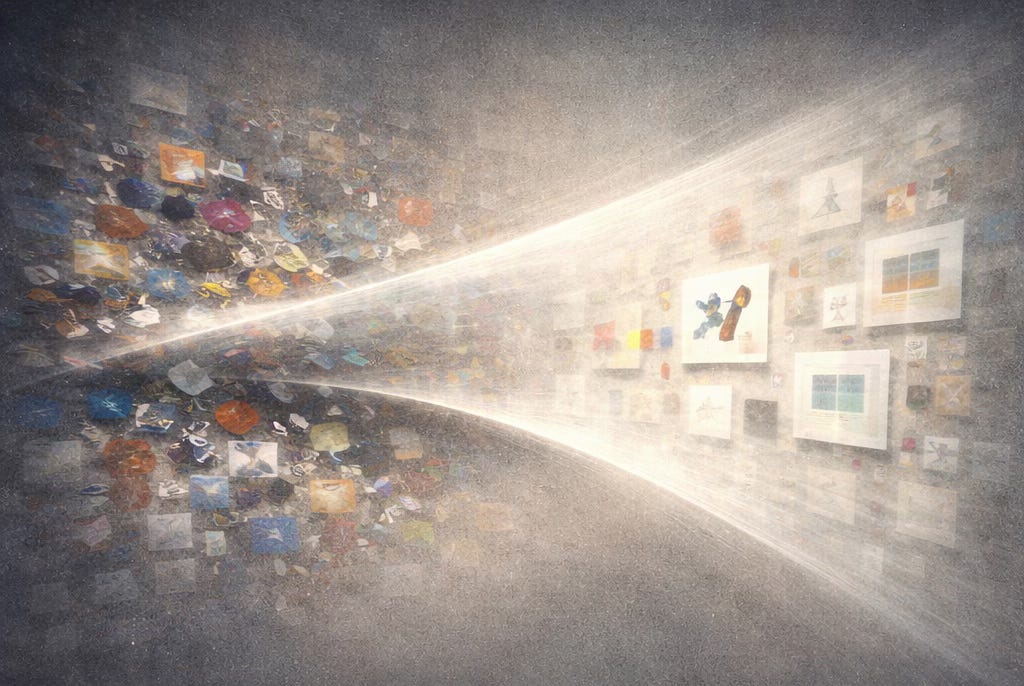
You’re no longer there to generate every idea. You’re there to shape the conditions where strong ideas can emerge, and more importantly, to recognize which ones are worth pushing forward.
That’s where taste comes in.
Not taste as in personal preference.
Taste as in judgment.
Does this solve the problem?
Does it align with the brand?
Does it hold up across channels and contexts?
Is it simply interesting… or actually effective?
That distinction is everything.
Because teams don’t need another set of hands. They need a filter.
Why the “Hero CD” Model Breaks Down
There’s a cost to being the best creative in the room.
It doesn’t scale.
It slows teams down.
And over time, it quietly erodes confidence in the people around you.
If every great idea ultimately comes from you, your team learns something — just not what you want.
They learn to wait.
They learn to defer.
They learn that their role is to execute, not to think.
And that’s when the work plateaus.
Not because the team lacks talent, but because the environment doesn’t demand it.
What Strong Creative Leadership Actually Looks Like
The best Creative Directors I’ve worked with — and tried to learn from — operate differently.
They don’t dominate the room.
They elevate it.
They ask better questions than anyone else.
They create space for ideas to be explored, challenged, and improved.
They know when to push, and when to let something breathe.
And when the work comes together, they apply a level of judgment that’s consistent, clear, and grounded in something bigger than personal taste.
That’s the part that takes time.
Because developing taste isn’t about having opinions. It’s about building a point of view that holds up across projects, clients, teams, and years.
It’s pattern recognition.
It’s context.
It’s knowing not just what works, but why it works.
A Slight Reframe
So no, the Creative Director isn’t just the “taste person.”
You’re still creative. You still have ideas. And sometimes, yes, you step in and help shape a direction when it’s needed.
But if that’s your default mode, you’re doing the job at the wrong altitude.
The real role is closer to this:
You build the system.
You define the standard.
And you ensure that everything that passes through it gets better.
Not because you touched every piece — but because your thinking did.
The Quiet Shift That Changes Everything
The moment this clicked for me wasn’t dramatic.
It was gradual.
I stopped trying to prove I was the best creative in the room, and started focusing on helping the room produce its best work.
The output improved.
The team grew.
And interestingly, the work started to feel less like “mine” and more like “ours.”
Which, in the end, is kind of the point.
Creative leadership isn’t about having all the answers. It’s about building the lens through which better answers can emerge. That’s something we think about a lot at Orbit — how to create clarity, raise the bar, and help good ideas become great ones. If that’s a conversation you’re navigating, I’m always up for it.